Kaiqi-
She explained her works clearly, it is detailed and easy to understand. Her diagrams are clear and that helps me to understand a lot. i like her answers^^
Sunday, July 17, 2011

Comment 2
Aleen :
Her Answer are detailed. However, the words are too small and its difficult for mii to read. She should also separate her answers into paragraphs. And that would be better.. greatly done:))
Comment 1
Ysabelle-
Her answer is interesting because it is filled with different colour that make readers feel like reading it till the end. It can be seen that she does puts in the effort to make her answers well explained. The blog is also simple and nice. Neatly done^^
Her answer is interesting because it is filled with different colour that make readers feel like reading it till the end. It can be seen that she does puts in the effort to make her answers well explained. The blog is also simple and nice. Neatly done^^
Sunday, July 10, 2011
5. Sodium is a metal and sulfur is a non-metal....why we classify them this way??

http://www.elementsdatabase.com/Images/periodic_table.gif
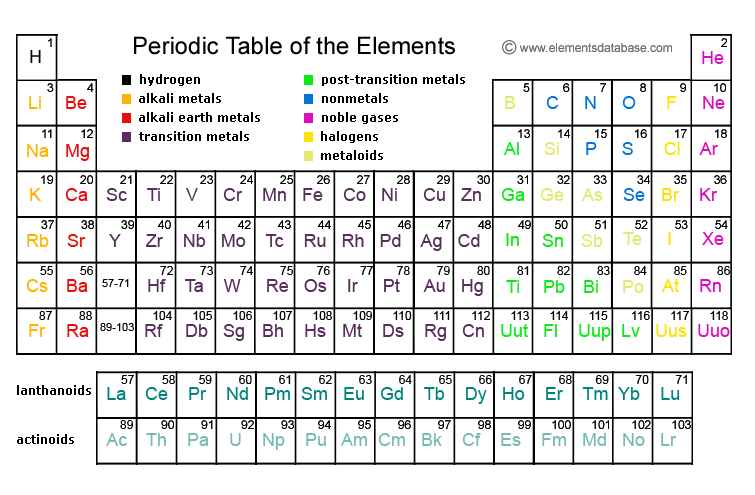

http://www.chemglobe.org/ptoe/periodic.png

Sulfur is a non-metal because:
1. it does not conduct electricity
2. it will gain electrons to complete the valence shell
3. it lies on top of the stair case on the table
Sodium is a metal because:
1. it conducts electricity
2. it will lose electron to complete the valence shell
3. it lies below the staircase (group1 )
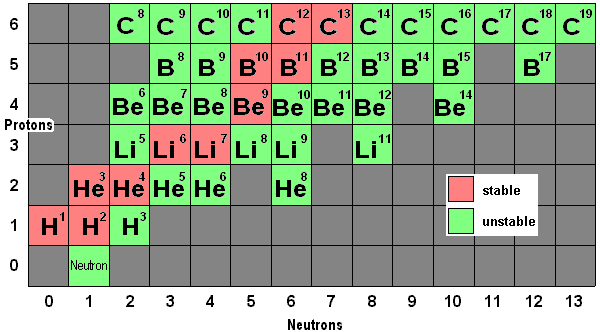
4. Chlorine-35 atom and Chlorine-37 atom are called isotopes...Use these two examples to explain what is 'isotopes'.
Isotopes are atoms of the same element that have different nucleon number (mass no.) or different number of neutrons.
Isotopes of the same element have similar chemical properties but different physical properties.
Since Chlorine-35 and Chlorine-37 have the same number of proton and electron but different number of neutron, they are called isotopes of chlorine. Thus, the average nucleon number of chlorine will be [(75/100) x35 ] + [(25/100) x37] = 35.5

http://alexteoh.com/Atomic%20Structure_files/image003.jpg

http://www.wordwizz.com/images/isotopes.gif
Isotopes of the same element have similar chemical properties but different physical properties.
Since Chlorine-35 and Chlorine-37 have the same number of proton and electron but different number of neutron, they are called isotopes of chlorine. Thus, the average nucleon number of chlorine will be [(75/100) x35 ] + [(25/100) x37] = 35.5
| Chlorine Atoms | No. of Proton | No. of Electron | No. of Neutron |
| Chlorine-35 | 17 | 17 | 18 |
| Chlorine-37 | 17 | 17 | 20 |
http://alexteoh.com/Atomic%20Structure_files/image003.jpg

http://www.wordwizz.com/images/isotopes.gif
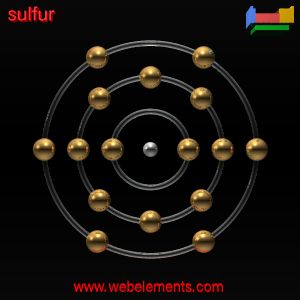
3. Draw the atomic structure of a sulfur atom and a sulfide ion....explain why you draw it this way.

http://www.micromountain.com/sci_diagrams/at_struct/at_struct_assets/sulphur_lab_usa.jpg

 Extra^^
http://www.webelements.com/_media/elements/kossel_diagrams/S.jpg

http://chemwiki.ucdavis.edu/@api/deki/files/4996/=Sulfate%20pt.%202.jpg


http://0.0.0.3/4.bp.blogspot.com/-Yy6H9WZQsK0/ThFsS_xMXJI/AAAAAAAAAEQ/bB0e3S_VoqU/s1600/Untitled-4jpg.jpg

Ionic bonds are formed when metallic atoms has given away their valence electrons to the non-metallic atoms.
The transfer of valence electrons from the metallic to the non-metallic atoms enables both atoms to achieve stablility. (stable noble gas configuration)
oppositely charges ions are formed which will attacted to each other due to the strong electrostatic forces of attraction, that form the ionic bonds.
THerefore, i drew the sulfur atom that way as its has 16 electrons .
Its electronic configuration is (2.8.6). It need 2 extra valence electrons to become stable . Thus,sulfide ion is drawn that way because it has gained 2 valence electron . Hence, its electronic configuration has become ( 2.8.8 ) after recieving two electron. and is now negatively charge
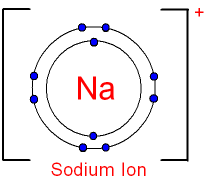
2. Draw the atomic structure of a sodium atom and a sodium ion....explain why you draw it this way.

https://blogger.googleusercontent.com/img/b/R29vZ2xl/AVvXsEhlF5vDL1_N-xq7plD6YADEOqZOn_0TwwOtFxNJxPzEmLsDj3I4-_kYVwdvngGZucfOZqdmlKdG5bBE1LQJAApqhVWY4ArXLh5slCDMKGu7b7EGWibg32m_mtGmQnGbWEeSoWQ6OXjxG47c/s320/Sodium-Atom-Sodium-Ion.gif

http://iss.cet.edu/electricity/pages/images/b/b11_5.jpg

Ionic bonds are formed when metallic atoms has given away their valence electrons to the non-metallic atoms.
The transfer of valence electrons from the metallic to the non-metallic atoms enables both atoms to achieve stablility. (stable noble gas configuration)
oppositely charges ions are formed which will attacted to each other due to the strong electrostatic forces of attraction, that form the ionic bonds.
THerefore, i drew the sodium atom that way as its has 11 electrons .

http://www.google.com.sg/imgres?imgurl=http://www.scioly.org/w/images/1/1b/Electron_shell_011_Sodium.svg.png&imgrefurl=http://www.scioly.org/wiki/GMOA_Notes&usg=__BWr41JgSP1sAjIKSHoywbKX933Q=&h=194&w=180&sz=10&hl=en&start=14&zoom=1&itbs=1&tbnid=M0tsb3vKAyYmyM:&tbnh=103&tbnw=96&prev=/images%3Fq%3Dthe%2Batomic%2Bstructure%2Bof%2Ba%2Bsodium%2Batom%2Band%2Ba%2Bsodium%2Bion.%26hl%3Den%26gbv%3D2%26biw%3D1003%26bih%3D622%26tbm%3Disch&ei=w7MZTqOSLsXVrQfGzPzPAQ

Its electronic configuration is (2.8.1). It has 1 extra valence electron. thus, sodium ion is drawn that way because it has given away it in order to become stable . Hence, its electronic configuration has become ( 2.8 ) after that removal of that electron. and is now positely charge

http://www.gcsescience.com/sodium-ion.gif
Subscribe to:
Posts (Atom)